
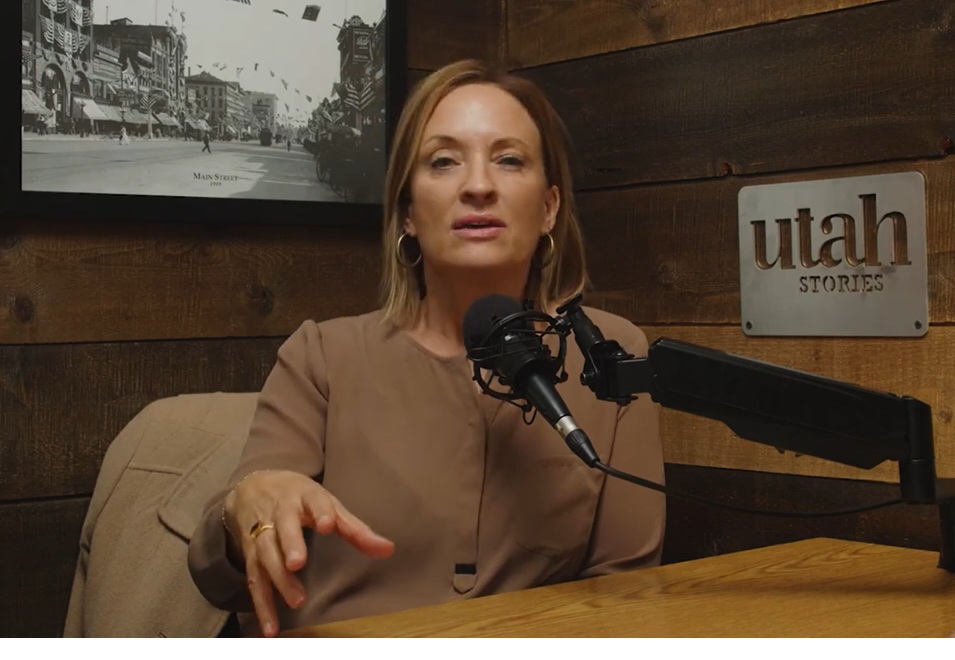
Celeste was five years old the first time she dragged a kitchen stool across the linoleum, climbed up to the stove, and made dinner.
On good days there was a blue box of mac and cheese from the food bank. If they were really lucky, there’d be a pack of hot dogs or some bacon to slice into the pot. She’d stir the noodles, cut the meat with careful little hands, and call it a gourmet meal. Then she’d walk her younger sister to school, help with homework, run the bath, and put her to bed.
While most Utah kids her age were learning to color inside the lines, Celeste was learning how to keep another human being alive.
Her father drifted in and out of jail and drug rehab. Her mother usually lay passed out on the couch, sleeping off hangovers and long nights with men and drugs. The grown-ups in the house didn’t mark time by dinner, bath, or bedtime. Celeste did.
“I knew enough to know she wasn’t doing her job,” Celeste says of her mom. “But I also knew enough to know I would need to do it for my sister.”
By seven years old, Celeste wasn’t anyone’s daughter in the way most people think of it. She was the mom.
In and out of “the system”
Her life didn’t start out that way. For the first 18 months, Celeste was being raised by an aunt and uncle. They already had a houseful of kids, but they loved her and wanted to keep her. Years later, Celeste would learn her aunt even asked to adopt her—with one condition.
“She said, ‘You can’t be involved in how we do that. We have to be able to parent her the way we parent our children,’” Celeste recalls. “And he said, ‘I can’t do it. I can’t promise I won’t interfere.’”
The deal died there. Her biological father chose the possibility of control over the certainty of safety.
At about 18 months, Celeste’s parents moved away from family “to figure this out on our own.” What followed was five years of drift and chaos. She bounced between relatives, foster homes, and her parents’ place. Sometimes she and her sister would go together. Sometimes people begged to keep her baby brother because he was so little.
By age seven, the state officially removed them. Her father was back in jail. Her mother’s addiction had swallowed up whatever was left of her ability to parent.
Most people assume this is where the story turns. Parents lose rights, kids go into foster care, things get better. For Celeste, they didn’t.
“I moved every six months until I was 16,” she says. “I lived in about 32, 33 cities.”
In between were “mother-child” drug rehab programs, including one that uprooted them from Salt Lake and dropped them in Detroit, Michigan. On paper, those programs allowed mothers to get clean without permanently losing their children. In practice, at least where Celeste landed, they were barely controlled chaos.
“You have little kids all the way up to almost-18-year-olds together, and you’re not even allowed to see your mom until she’s at a certain level in the program,” she says. “We basically managed ourselves. That’s not going to go well.”
Children who’ve already learned to parent themselves simply become young generals in a kid-run unit. In Celeste’s case, that meant fighting other kids and stepping into situations no child should have to navigate.
“I chose to fight, to put myself in harm’s way to protect my sister,” she says. “Later it made it hard to see myself as abused, because in my mind, I chose it. I wasn’t thinking ‘I’m a victim.’ I was thinking, ‘Look at me taking charge. Look at me keeping her safe.’”
The parentified child in a foster world
If you’ve never seen it up close, “parentified child” sounds like another clinical label. If you’ve lived it—or tried to parent a kid like that—you know it’s anything but abstract.
My own family took in three foster siblings. The oldest was six and arrived in our home with his shoulders squared and jaw set like a tiny drill sergeant.
“He was exactly like you,” I tell Celeste. “He’d say, ‘Just so you know, I’m in charge of these two.’ He coached us: ‘Here’s how you calm Riley down. Here’s what you do with Abby.’”
Like Celeste, he wasn’t really acting like a child. He’d become the caretaker, without the brain development or support to do it.
“You think your decisions are better than what happened to you,” Celeste says, “but your brain’s not developed enough, and nobody’s taught you how to make healthy decisions. And yet you know enough to know something has to be managed.”
That constant managing keeps kids stuck in fight-or-flight. One therapist described it to us as a train without brakes trying to pull into a station. The child wants to calm down, but doesn’t have the internal wiring to do it.
“It feels chaotic and unstable, putting it mildly,” Celeste says. “Only time and consistency can help a kid start to regulate. If you move them every six months, you never get either.”
“Broken” or just brutally complicated?
Listening to stories like Celeste’s, it’s easy to slap one big label on Utah’s foster care system: broken.
We felt that way. The three siblings who came to us were bright and funny. Ninety-seven percent of the time, life with them was joyful: playing in the mountains, trips to Moab, board games, laughing with the dogs. The other three percent was absolute crisis: kids beating on each other, getting kicked out of school and daycare, becoming pariahs at karate class.
That three percent slowly swallowed all the oxygen in the house.
As behaviors escalated, more professionals got involved—caseworkers, attorneys, therapists. Too often, it felt like the machinery of the system was trying to solve its own problems, not understand the children at the center of them. At one point, it felt like the state was more interested in removing the kids than helping them heal.
“We felt like the system was hell-bent on destroying the kids,” I tell Celeste.
She doesn’t flinch.
From her vantage point—as someone who lived it and now works alongside the people running it—Celeste resists the simple “broken” verdict.
“People ask me all the time if I think the system is broken,” she says. “And my answer is no, it’s complicated.”
Coming from her, that’s not spin. She’ll tell you bluntly: “I feel like the system failed me 100 percent.” She can’t point to one thing it did that felt good or healing at the time.
But as an adult, she can see what she couldn’t as a kid shuttled from house to house: massive gaps. Service gaps, resource gaps, legal gaps. People inside the system working under mandates and timelines most foster families never see.
“Children aren’t designed to be raised by a system,” she says. “That’s the problem. They’re designed to be raised by a healthy community and a family. So when we take them out of any chance of that happening—even if there was dysfunction there—and put them into this clunky system, it’s chaos.”
