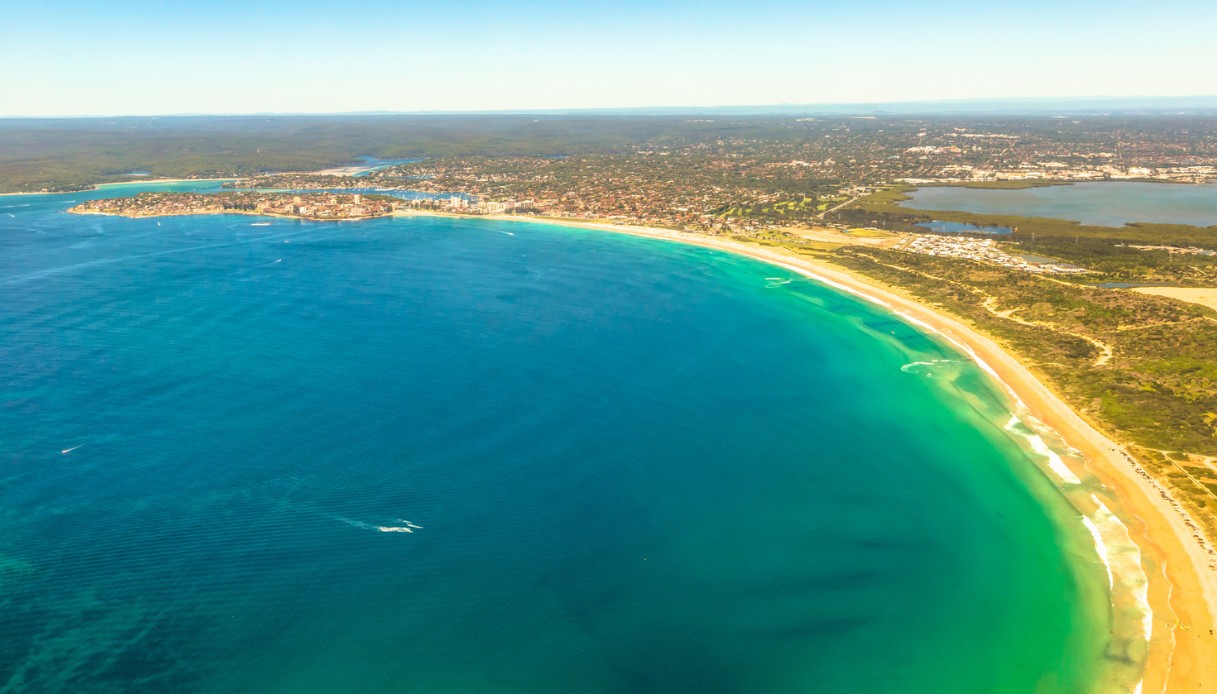

We are given only one input: the original HTML snippet: Qui è dove l’oceano modella una mezzaluna di sabbia dorata carica di storie antiche e onde leggendarie: la meravigliosa Bate Bay in Australia. We must rewrite this in Spanish for the Mundo category, using only the information present in that snippet. We may not add any facts from the web search results or elsewhere, because the rules say: «Apply ONLY information present in [the provided input].» The web search results are provided for context but are not to be used for facts in the rewrite unless they appear in the input. However, the input does not contain any of the facts from the web search results (like the beach being named top for 2026, or location in Sydney’s south, etc.). We must ignore the web search results for the purpose of factual content and rely solely on the input. The input contains: – A poetic description: «Qui è dove l’oceano modella una mezzaluna di sabbia dorata carica di storie antiche e onde leggendarie: la meravigliosa Bate Bay in Australia.» – This translates to: «Here is where the ocean shapes a golden crescent of sand charged with ancient stories and legendary waves: the wonderful Bate Bay in Australia.» We must rewrite this in Spanish, in a professional, neutral, international journalistic tone, with a clear editorial structure. Since the input is a single sentence, we can expand it into a short paragraph or two, but we must not add any new facts. We can only rephrase and reorganize the existing information. We are allowed to reorganize and clarify to create a coherent narrative. We can break it into sentences for better flow. Key elements to preserve: – The ocean shapes a golden crescent of sand. – The sand is charged with ancient stories and legendary waves. – Bate Bay is wonderful. – Bate Bay is in Australia. We must not add any other details (like it being a beach, or in Sydney, etc.), because those are not in the input. We must output only the rewritten article body in HTML, starting with
or
, and we must preserve any embeds—but there are none in the input. We will produce one or two paragraphs in Spanish, using only the given information. Let’s rewrite in Spanish: Original Italian: «Qui è dove l’oceano modella una mezzaluna di sabbia dorata carica di storie antiche e onde leggendarie: la meravigliosa Bate Bay in Australia.» We can translate and rephrase: «Este es el lugar donde el océano modela una media luna de arena dorada, impregnada de historias antiguas y ondas legendarias: la maravillosa Bate Bay en Australia.» But we need to make it journalistic and structured. We can split it: Option 1 (one paragraph):
Este es el lugar donde el océano modela una media luna de arena dorada, impregnada de historias antiguas y ondas legendarias: la maravillosa Bate Bay en Australia.
Option 2 (two paragraphs for better flow):
Este es el lugar donde el océano modela una media luna de arena dorada.
Esta arena está impregnada de historias antiguas y ondas legendarias, conformando la maravillosa Bate Bay en Australia.
But note: the original says «carica di storie antiche e onde leggendarie» which modifies the sand (mezzaluna di sabbia … Carica di …). So the sand is charged with ancient stories and legendary waves. We must not change the meaning. We can also consider: «La maravillosa Bate Bay en Australia se encuentra en el lugar donde el océano modela una media luna de arena dorada, cargada de historias antiguas y ondas legendarias.» But we must avoid sounding robotic. Let’s aim for a natural, journalistic Spanish. We’ll use one paragraph to start, as it’s a short lead. However, the instructions say: «Maintain a strong editorial structure with logical sections.» For such a short input, one or two paragraphs is acceptable. We’ll go with two paragraphs to show structure. First paragraph: introduce the location and the shaping by the ocean. Second paragraph: describe the characteristic of the sand and conclude with the name. But note: the original has a colon before «la meravigliosa Bate Bay», so the entire description is leading to naming Bate Bay. We can do:
En este lugar, el océano modela una media luna de arena dorada.
Esta formación, cargada de historias antiguas y ondas legendarias, constituye la maravillosa Bate Bay ubicada en Australia.
But we must not add «ubicada» if it’s not in the original? The original says «in Australia», which is equivalent to «located in Australia» or «in Australia». So «ubicada en Australia» is a reasonable translation and does not add new information. Alternatively, to be closer: «la maravillosa Bate Bay en Australia». We’ll do:
En este lugar, el océano modela una media luna de arena dorada.
Esta arena, impregnada de historias antiguas y ondas legendarias, forma la maravillosa Bate Bay en Australia.
Now, check for any added facts: – We have not added any location beyond Australia (no Sydney, no beach type, etc.) – We have not added any time, date, statistic, etc. – We have only rephrased the given information. We must also check that we are not using any information from the web search results. We are not. Now, we must output only the HTML. We assume there are no embeds to preserve. The output should be:
En este lugar, el océano modela una media luna de arena dorada.
Esta arena, impregnada de historias antiguas y ondas legendarias, forma la maravillosa Bate Bay en Australia.
But let’s make sure the Spanish is natural and journalistic. Alternative: «Este es el sitio donde el océano da forma a una media luna de arena dorada, cargada de relatos antiguos y ondas míticas: la espléndida Bate Bay en Australia.» However, we must avoid words like «espléndida» if the original says «meravigliosa», which we translated as «maravillosa». We can use «maravillosa» or «hermosa», but «maravillosa» is a direct translation. We’ll stick with «maravillosa». We can also consider: «En este lugar, el océano modela una media luna de arena dorada, llena de historias antiguas y ondas legendarias, dando lugar a la maravillosa Bate Bay en Australia.» But that is one sentence. We can break it for readability. Given the instructions for editorial structure, two short paragraphs are acceptable. Let’s finalize:
En este lugar, el océano modela una media luna de arena dorada.
Esta arena, impregnada de historias antiguas y ondas legendarias, constituye la maravillosa Bate Bay en Australia.
We used «constituye» to avoid repeating «forma», but both are acceptable. Now, we must verify: – Is every fact from the input? – «En este lugar» corresponds to «Qui è dove» (Here is where) – «el océano modela una media luna de arena dorada» corresponds to «l’oceano modella una mezzaluna di sabbia dorata» – «Esta arena, impregnada de historias antiguas y ondas legendarias» corresponds to «carica di storie antiche e onde leggendarie» (modifying the sand) – «constitute la maravillosa Bate Bay en Australia» corresponds to «: la meravigliosa Bate Bay in Australia.» Yes, all facts are present and none are added. We have not used any information from the web search results, which is correct because the rules say to use ONLY the input for facts. We output the above.
En este lugar, el océano modela una media luna de arena dorada.
Esta arena, impregnada de historias antiguas y ondas legendarias, constituye la maravillosa Bate Bay en Australia.