
Before he could walk, Aaron Benjamin’s parents put oars in his hands. He had rafted the Grand Canyon several times, and was defined by his friends as an experienced boater.
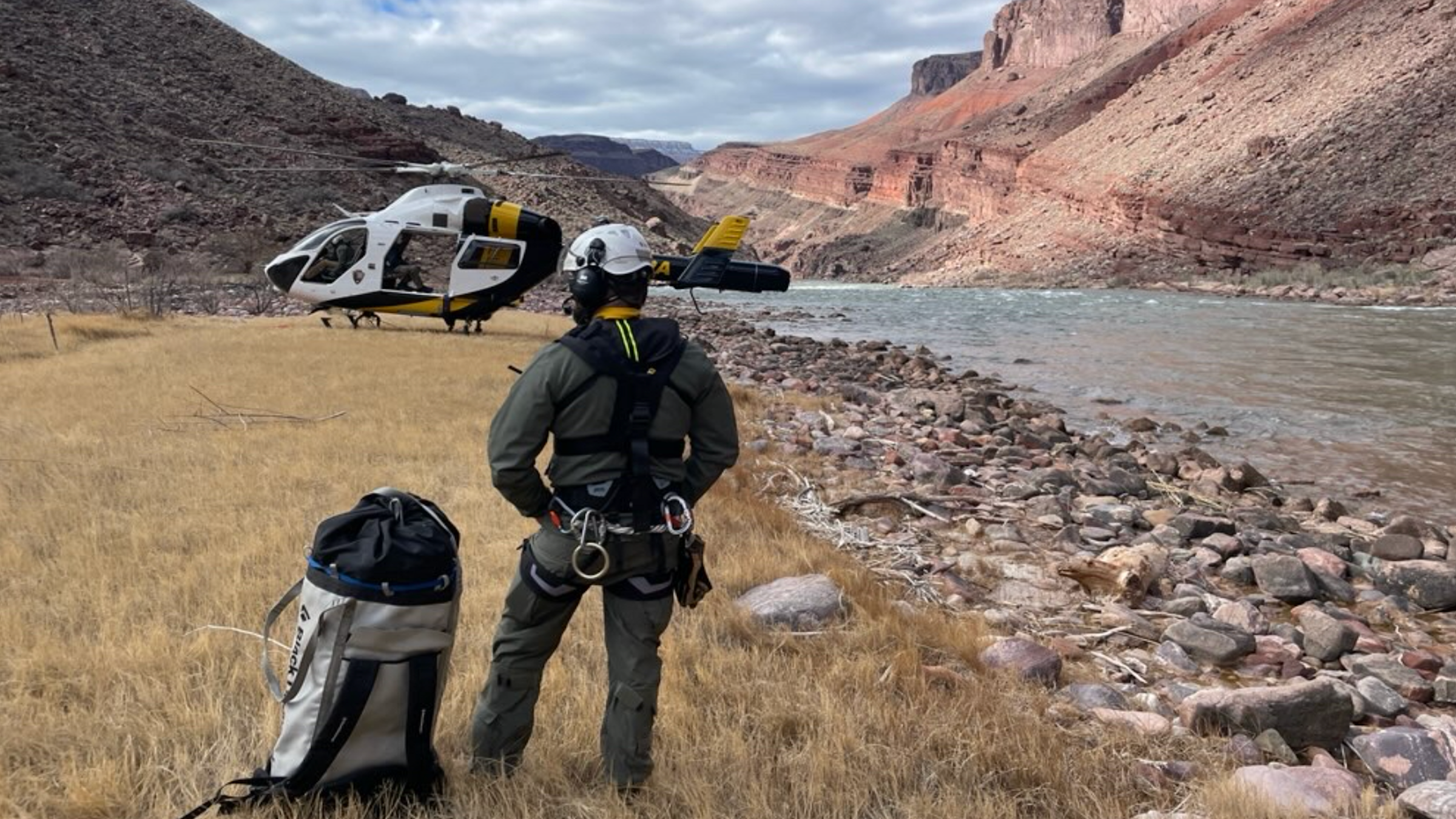
NPS response to Hance Rapid on Feb. 19, 2026 (Photo: NPS)
Published February 23, 2026 02:45PM
An Idaho man died in mid-February after an accident on one of the Grand Canyon’s most technical stretches of whitewater. Aaron Benjamin, 30, drowned on February 19 while solo-captaining a raft in Hance Rapid, a formidable section of the Colorado River.
The National Park Service (NPS) wrote in a news release that the responders received an emergency alert at 11:15 A.M.
Alan DeKalb, 67, was a member of the ten-person private river trip. DeKalb told Outside that Benjamin—who was rowing an 18-foot raft alone—was the last member of their party to run the rapid. The first sign of trouble came when other paddlers who had already reached the bottom looked upstream to watch Benjamin go down. They could see his raft, but it was empty.
“Nobody actually saw him go over,” DeKalb said. Dekalb ran the rapid shortly before Benjamin, and he was also separated from his own boat. “People in our group could just see Aaron’s empty boat stuck up there.”
DeKalb said Benjamin’s raft appeared to be stuck on a rock or caught in a “hole,” a powerful hydraulic feature. Eventually, the raft washed free and drifted to the bottom of the whitewater section. Roughly two minutes later, Benjamin’s body floated down, too. He was face down in the water, and he was unconscious.

The group reacted immediately, DeKalb said. DeKalb has 30 years of experience as a paramedic, and another member of the party was a veteran trauma nurse. They pulled Benjamin from the water and began resuscitation immediately.
“You couldn’t have asked for a better group to do the resuscitation,” DeKalb said. “We followed our Advanced Cardiovascular Life Support (ACLS) protocols, we did 20 minutes of CPR, but eventually we had to pronounce him dead.”
Hance Rapid, located at river mile 77, is one of the longest and most technical rapids on the Colorado River. It’s also very rocky.
“If you fall out, you’re going to hit some rocks on your way down,” DeKalb said.
Another of the rapid’s defining features is the massive hole at its top. A hole occurs when water flows over a submerged rock or ledge and curls back on itself, creating a washing-machine-like effect that can trap a boat (or a person) in place. Hance has claimed other lives as well, including Mary Kelley, 68, who drowned there in 2022.
DeKalb rowed the rapid just moments before Benjamin. He capsized his own kayak in the same hole, was sucked underwater, and swam out of his boat. The rapid eventually spat him out, and he managed to hop back into his kayak in an eddy—a spot of still water—and paddle the rest of the way down. It was only when he reached the calm water below that he realized the group was gathering around Benjamin’s unconscious body.
DeKalb said he did not know Benjamin prior to the trip, but spoke to Benjamin’s parents after his death.
Benjamin was a resident of Post Falls, Idaho, who DeKalb said was an experienced boater who had paddled many rivers in Idaho and run the Grand Canyon before.
“He grew up on the river,” DeKalb said. “His parents have done the Grand Canyon multiple times, and Aaron had done it multiple times. Before he could walk, they put a pair of oars in his hands.”
DeKalb said it was hard to say what exactly went wrong, but that the group believes that when Benjamin’s raft was seen stuck in the hole at the top of the rapid, he was underneath it, and that he drowned during this time.
“But really, nobody knows what happened,” DeKalb admitted. “He was seen sitting in the boat, then the boat was seen stuck up there, and he wasn’t in it anymore.
Lectura relacionada
