
BEIJING, Jan. 13 (Xinhua) — A group of Chinese researchers revealed that the volatile loss from the lunar mantle was induced by the giant impact that formed the South Pole-Aitken (SPA) Basin in the moon’s far side, providing crucial evidence for understanding the impact of large-scale collisions on the lunar evolution and for uncovering the causes of different nature of moon’s near side and far side.
The study was published in the Proceedings of the National Academy of Sciences on Tuesday.
Since the formation of the moon, asteroid impacts have been the dominant geological processes triggered by events outside the Moon, producing impact craters and basins across the lunar surface and profoundly modifying its topography and geochemical characteristics. However, the extent to which large-scale impact events have affected the moon’s deep interior remains unclear.
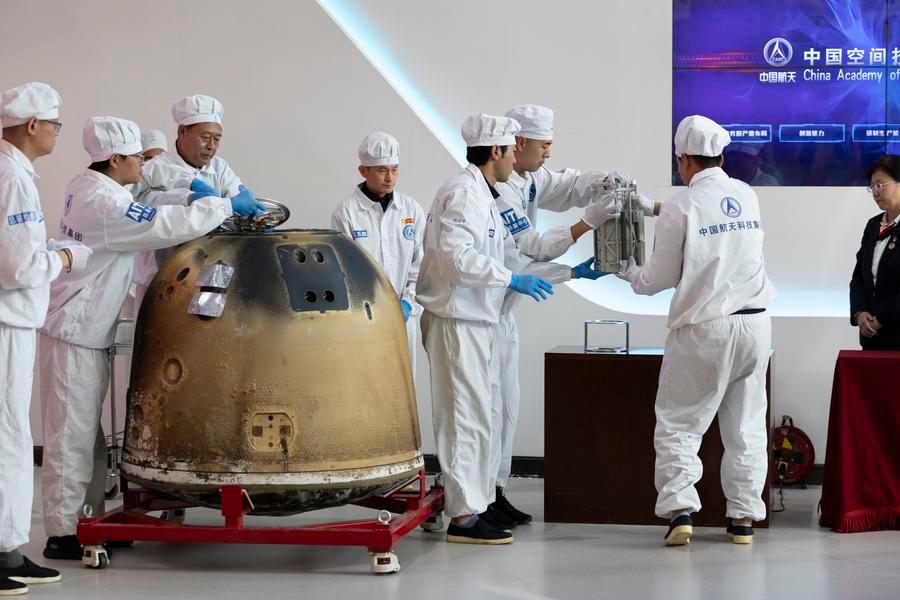
A research team led by Tian Hengci from the Institute of Geology and Geophysics, Chinese Academy of Sciences, examined the isotopic compositions of potassium (K) in Chang’e-6 lunar basalts collected from the SPA basin.
The isotopic systems of moderately volatile elements, such as K, are prone to volatilization and fractionation under the high-temperature conditions generated by impacts. Their compositions can record information such as temperature, pressure, and material sources during impact events, making them key evidence for revealing impact scales, thermal histories, and their modifications to the lunar crust and mantle materials.
The team found that the Chang’e-6 lunar basalts exhibit significantly heavier K isotopic compositions than all previously reported lunar basalts from Apollo missions and lunar meteorites. They then evaluated potential mechanisms that could modify the K isotope composition, including long-term cosmic-ray irradiation, magmatic differentiation and impactor input. However, the results indicated that these factors have only a minor effect.
Further research demonstrated that the impact events altered the K isotope composition of the lunar mantle, leading to an increase in isotope values. During the high-temperature and high-pressure processes generated by impacts, lighter K isotopes were preferentially lost compared to heavier ones, resulting in elevated isotopic ratios in the remaining materials.
The study also suggests that this volatile depletion may have suppressed magma generation and volcanic activity on the far side of the Moon, potentially contributing to the well-known asymmetry in volcanic activity between the near and far sides. ■
