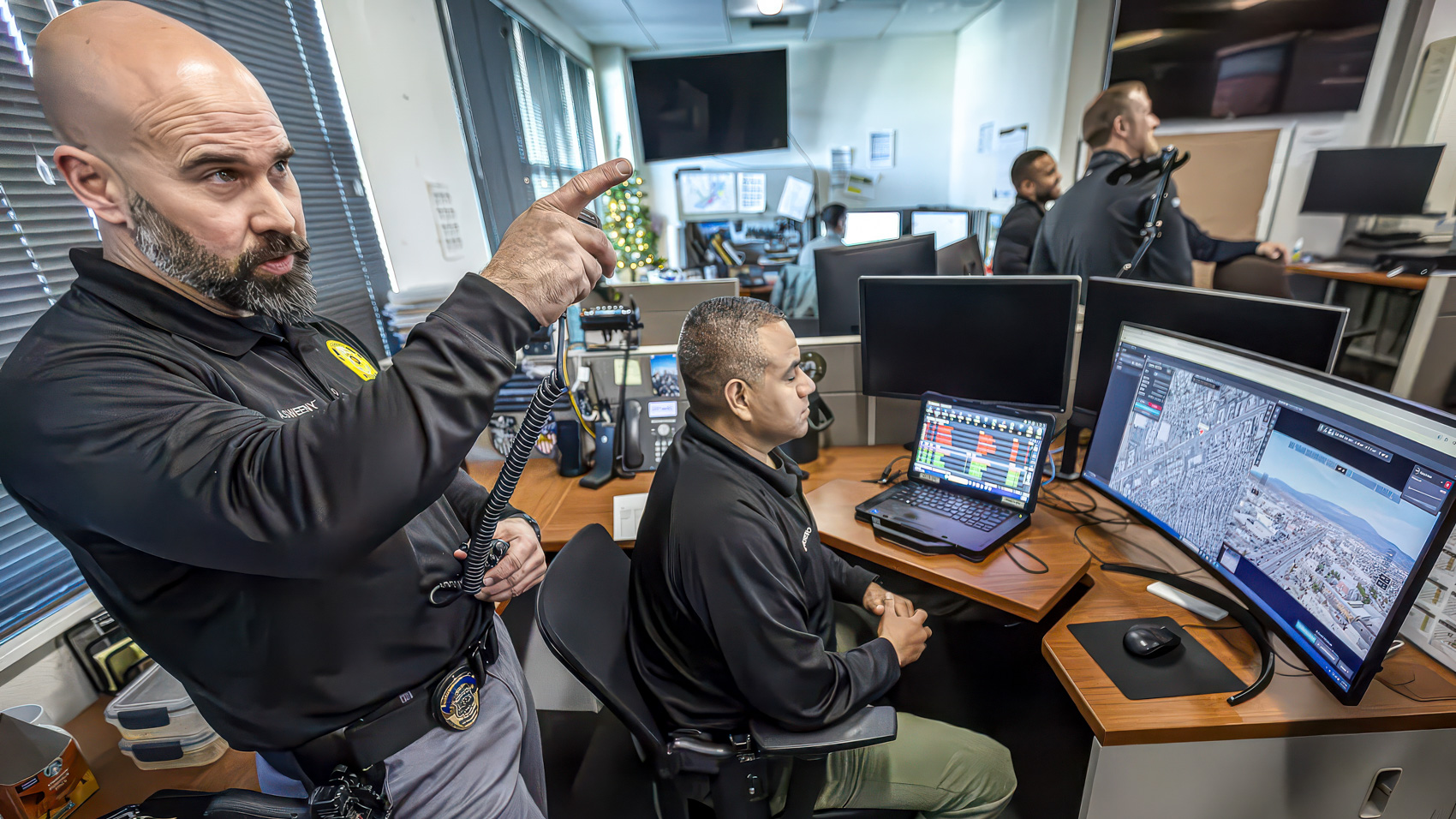
A woman passed counterfeit bills at three businesses on Cerrillos Road. Instead of sending a patrol officer to drive the corridor looking for her, Santa Fe police clicked a mouse and put a Skydio X10 in the air, as Santa Fe New Mexican reported.
Two minutes after launch, the drone was hovering above the intersection of Cerrillos Road and Cielo Court. No traffic. No repositioning. No cruiser circling the block hoping to spot someone matching a description.
That is not the future of policing in Santa Fe. That is Thursday afternoon.
A Mouse Click and Two Minutes
Detective Enrique Moreno was sitting at a computer inside the station on Camino Entrada when the counterfeit bill calls came in. The dock outside the building opened. The drone lifted. Within two minutes it was on scene and streaming live video back to the station.
Santa Fe police have been operating drones since August 2023 and have logged hundreds of deployments across missing persons searches, crash documentation, suspect apprehension, and felony support. Nine FAA-certified pilots now operate the fleet across a range of missions.
What Thursday represented was something different. Not a drone dispatched after officers, not a drone called in as backup. A drone dispatched instead of a patrol unit, as the primary response tool, precisely the model that defines a true DFR program.
Deputy Chief Ben Valdez has presented a proposal to city council to cover the costs of 15 drones stationed at five locations around the city, in conjunction with Axon and Skydio. MCA The City Council must approve a new contract before the program becomes permanent. That vote has not happened yet.
What Fifteen Drones at Five Stations Changes
The Skydio X10 flying Thursday’s counterfeit bill call carries a 640×512 FLIR Boson+ thermal sensor, a 64-megapixel narrow camera, and a 48-megapixel telephoto with 128x digital zoom. It deploys from a Skydio Dock in under 40 seconds, flies at 35 miles per hour, and can stay airborne for 40 minutes.
It operates in a two-mile radius from its docking station and handles rain, wind, and darkness without flinching.
At full deployment across five sites, coverage overlaps across the entire city. A priority call anywhere in Santa Fe falls within reach of at least one drone. Average response time for high-priority calls in Santa Fe was six minutes in April 2024. A docked Skydio X10 cuts that to under three.
A representative from Axon noted that in Lakewood, Colorado, drones beat officers to the scene almost half the time, and nearly 40 percent of Lakewood’s calls are now cleared without an officer attending the scene at all.

MCA Deputy Chief Valdez said the technology could help offset ongoing staffing shortages at SFPD. That is not a small consideration for a department that has struggled to fill patrol positions for years.
The Concerns Are Real and They Deserve to Be Named
The program has opposition, and it is not all reflexive technophobia.
The ACLU has warned that DFR technology, combined with tools like facial recognition and license plate readers already deployed at SFPD, creates powerful surveillance infrastructure with limited independent oversight.
The Electronic Frontier Foundation has called for mandatory data retention policies, audits, and clear use restrictions before departments adopt DFR at scale.
Community voices have been direct: “Our city has an opportunity to fund community resources to change the condition, mental health, youth programs, substance abuse treatment, but they continue to prefer systems that jail people rather than support them.” Business Wire
These are legitimate arguments. A drone that clears 40 percent of calls without an officer attending the scene is also a drone collecting 40 percent more aerial footage of a city’s streets, neighborhoods, and residents. The question of who reviews that footage, how long it is stored, and under what circumstances it can be accessed is not answered by how fast the aircraft flies.
Santa Fe’s existing drone policy prohibits use for random surveillance and requires a documented call for service before any deployment. Whether that framework is strong enough for a 15-drone citywide network operating around the clock is exactly what the City Council debate needs to answer.
DroneXL’s Take
Here’s what I actually think: Santa Fe is at the most important decision point in this program’s history, and getting it right matters more than getting it fast.
The technology works. Thursday’s counterfeit bill call proved it again. The man saved near Las Acequias Park last month proved it in a way nobody can argue with. The Skydio X10 is a capable aircraft, the Axon integration is solid, and the operational case for DFR in a city with staffing shortages and a rising call volume is straightforward.
The honest part is this: a 15-drone network operating at full capacity is categorically different from a few aircraft deployed as supplemental tools. It is a persistent aerial presence over a city. The communities that have navigated that transition successfully, Chula Vista, Lakewood, Fairfax County, did it by building community trust before scaling, not after.
Santa Fe has a life saved on the record. It has demonstrated technology. And it has a City Council that has not yet voted. That sequence is actually the right one. Use it well.
Photo credit: J. Weber/The New Mexican, Skydio.
Discover more from DroneXL.co
Subscribe to get the latest posts sent to your email.
Sigue leyendo